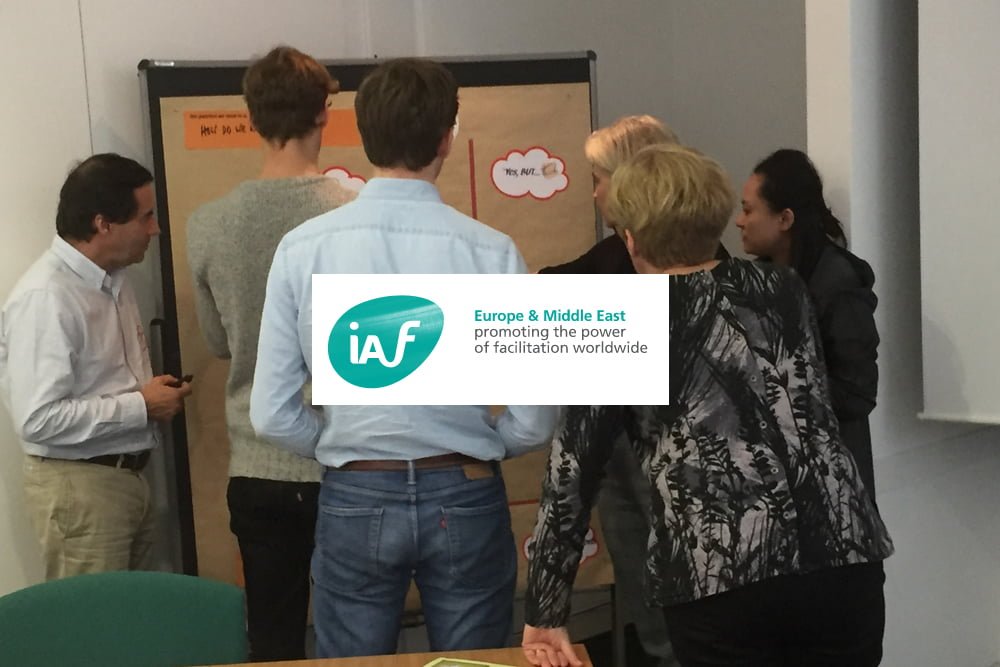
This was a very swift run-through of some of the stages of a typical Pinpoint session. Key points were process not content – indeed the content was deliberately simple and contained many assumptions. We did not complete any process step but we did dip in briefly.
Note: Prior to this session we did not create any prep. We went through over three hours work in just one, cutting many corners.
Thank you to all who took part and thank you too for the comments afterwards.
The Road Map
A bit of background including theories of how people vary in the ways they work and think. Belbin, Honey and Mumford, De Bono and in particular Howard Gardner.
The essence of the session was to show ways to ensure we, as facilitators, offer our activities in such a way that we cater for and appeal to all the various types of people in our groups.
Participation is pretty easy to achieve. True engagement brain, body belief takes a bit more.
Entry Board
Rather than around the table introductions (which can be stressful for some), we ask attendees to sign in as they enter the room. While they have their tea/coffee (with suitable music in the background), the board begins to stimulate chat and can be referred to whenever required.
This gets the attendees to focus on the objective. We also had on the table a word search for people to play with. This has two functions when time allows – to create chat, as well as give a future memory of learnings that will follow in the session.
Action plan
Starting with the end in mind – in this case either a group action plan or an individual one.
Trailer
This quick process is designed to get people off their seats, make a decision and ‘do’ something. It makes for a good focus and gets minds working.
Card Call
Idea generation with cards/post-it notes will be a familiar process to you all. As Cari suggested in the session, there are many names for this type of process.
A key point of Pinpoint is to ensure the cards are placed under the direction of the group. Avoid arguments about where something goes by placing a duplicate in another group. If a card comes up and a severe objection is raised, mark it with a red flash and ask the objector to write on another shaped card their rationale and place it adjacent to the original card. This tends to remove any emotion and allows progress again.
Needless to say there are now many processes we could use to follow up once we have prioritised the groups. In Pinpoint we use dots for prioritising with a particular formula for allocation and placing.
In this session we used a pre-designed template. Attendees select the topic of their choice and work in sub groups to come up with recommendations. There are various guide lines to help this process, but the key one was confirmed. Writing cards before you talk ensures more ideas get up on the board and stops the time being wasted by talking in depth about things that are unimportant.
Options
Each group presents their recommendations – good with some groups, often unsatisfactory with others.
In Pinpoint we have a gallery. Each group studies each of the others’ boards and places a heart on the recommendations they agree with and a question mark on those that they disagree with or do not understand.
It’s our job as facilitators to gain consensus and Pinpoint has ways to help do this. Once the recommendations are agreed, groups can fill in the final action plan.
Final Word
As facilitators, I am sure you could use the tools in the Pinpoint range in all sorts of ways and I would hope they would give you added power in your work.
To be a Pinpointer you’ll need to attend a training workshop. New or experienced, you will find a bucketful of ideas for events from 1:1 to 1:1000 when you attend our basic course. We use the kit and accelerated learning processes. In 40 years I have never been asked to give money back – but it is a promise if you don’t get your money’s worth.